

How does LifeSkills support careers education in England?
Help your students get ready for the world of work by discovering how LifeSkills aligns with the national curriculum and your responsibilities under the Careers Strategy. Content is mapped to the Gatsby Benchmarks to support your delivery and mapping can be found in this guide.
LifeSkills can support your careers provision, your work with SEND/ALN learners and your development of a whole school/college approach to building skills.
Explore the tabs below to see how our resources can be embedded into your employability work, supporting you to help young people develop the right skills and knowledge for the workplace.
What’s the national approach to careers education and skills development in England?
The Government’s Careers Strategy[1] sets out a long term plan to build a world class careers system that helps young people and adults choose a career that is right for them. It aims to enable:
- All young people to understand the full range of opportunities available to them, to learn from employers about work and the skills that are valued in the workplace and to have first-hand experience of the workplace
- All young people in secondary school and college to get an excellent programme of advice and guidance that is delivered by individuals with the right skills and experience
- Everyone to get support tailored to their circumstances. All adults should be able to access free face-to-face advice, with more bespoke support for those who most need it
- Everyone to get the information they need to understand the job and career opportunities available, and how their knowledge and skills can help them in considering suitable careers
To achieve these goals, the Careers Strategy recommends that schools and colleges should follow the Gatsby Foundation Benchmarks[2], which set out eight principles that form a framework for good careers guidance. These benchmarks were updated in 2024 to build on the success of the first ten years and ensure they remain relevant and continue to support excellence in careers guidance. Changes highlighted the importance of personalising careers information, linking it to all subjects, and supporting learners with additional needs.
By meeting these updated Gatsby Benchmarks schools and colleges can be confident that they are fulfilling their career education duties, which includes offering independent careers guidance, providing opportunities for organisations to inform students about technical education and apprenticeships, and offering regular employer engagement activities. Schools can audit their own progress against the benchmarks by using the Compass Plus tool from the Careers and Enterprise Company.
You can find statutory guidance on the Careers Strategy for governing bodies, school leaders and school staff here[3].
How does LifeSkills align with recent developments in education?
In recent years, Gatsby Benchmark 1 has encouraged institutions to create a stable whole school/college approach to careers education, in particular linking careers with learning across the curriculum (Gatsby Benchmark 4). This means that all educators have a role to play in developing students’ aspirations and knowledge about career options. LifeSkills resources support this approach by linking to a wide range of subjects, helping students connect skills development to future career choices.
The Government has affirmed the importance of supporting skills development, founding the new independent body Skills England to coordinate skills across the country. It has committed to working with the schools system to emphasise the importance of skills and support schools to provide high quality advice to students. LifeSkills can also support the Government’s Youth Guarantee, which aims for all young people to be earning or learning by expanding work experience and careers guidance.
T-levels technical qualifications were launched in 2020 as a two-year post-16 qualification, equivalent to three A-levels. The programme includes a minimum of 45 days’ industry experience and can be a direct route into employment or higher technical qualifications. LifeSkills resources can help students build their work readiness before their industry placements, enable them to reflect on the skills they develop and capture them on their CVs, ready for their next step.
How does LifeSkills help students develop core transferable skills?
LifeSkills provides a wide range of lessons, tools, content and resources that help students build the core transferable skills they need to succeed in the world of work. Find out more in the core transferable skills suite.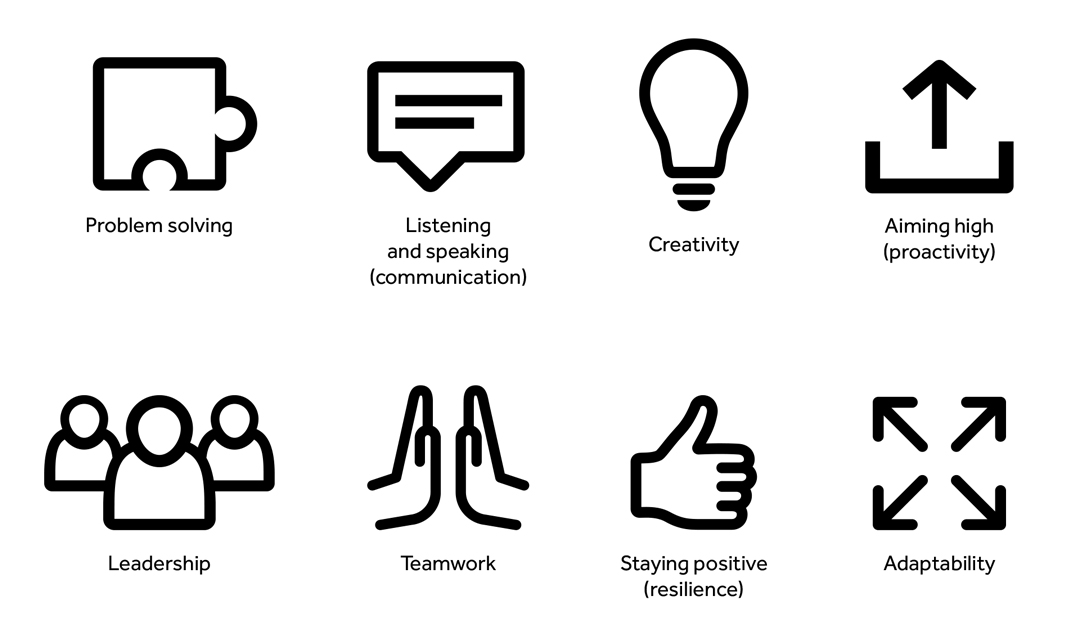
The programme also supports young people prepare for work by raising their awareness of the skills they are learning in education and how they can be useful in a work context. This in turn helps them to articulate and promote their skills when applying for jobs across different sectors.
The core transferable skills align with the skills that your students are already developing across the curriculum and tie in with the Essential Skills promoted by the Skills Builder Partnership in their Universal Framework[5].
The world of work is undergoing significant changes, driven by new technology, sustainability targets and changing working habits. That means it’s important for students to understand the skills employers are now looking for and how these have changed – to find out more take a look at our Your guide to the green jobs of the future. You can also learn more about employment trends here.
[1]https://assets.publishing.service.gov.uk/media/5a822a5c40f0b6230269b2f3/Careers_strategy.pdf
[2] http://www.goodcareerguidance.org.uk/
[3]https://assets.publishing.service.gov.uk/media/63b69f3fe90e077246c83323/Careers_guidance_and_access_for_education_and_training_providers_.pdf
[4] https://www.gov.uk/government/publications/skills-for-jobs-lifelong-learning-for-opportunity-and-growth
What key education frameworks and qualifications can LifeSkills support?
We have mapped LifeSkills content to the national curriculum in England to enable educators to use the resources across subject areas. Look at our Content curriculum guide to find lesson materials and independent learning resources for students that support your curriculum delivery.
As well as curriculum subjects and careers, LifeSkills content can support delivery of PSHE, in particular around wellbeing and financial education. Many of the resources have been awarded the Young Money quality mark.
How can LifeSkills support my school/college’s careers provision?
If you lead and coordinate delivery of careers and employability across your organisation, this Delivering employability skills across your school presentation and delivery notes are packed with useful insights and tips. You can deliver this to colleagues in your school, to help them embed employability into their subjects and departments and develop a consistent whole-school approach to preparing your young people for the future workplace.
LifeSkills can help your school/college meet the Gatsby Benchmarks. Research by the Careers and Enterprise Company in 2023 found that schools are achieving an average of 5.5 benchmarks out of eight[1]. With over 150 hours of engaging lesson plans and resources, LifeSkills can be an integral part of your school in linking to the curriculum and achieving more of the benchmarks. Download our helpful Gatsby mapping guide to find content that can help.
Supporting with inclusivity?
As part of Gatsby Benchmark 3 (addressing the needs of each young person) schools and colleges should have a programme of careers activities that actively challenges stereotypes, raises aspirations and is tailored to the individual needs of the learner. The updated Benchmark highlights the importance of taking into consideration the needs of ‘vulnerable and disadvantaged pupils, young people with SEND and those who are absent’.
LifeSkills offers adapted resources for students with Special Educational Needs and Disabilities (SEND), helping to set goals and prepare for the workplace.
This includes a core set of lessons adapted for young people aged 14+ with SEND and a navigation guide to explain how the content has been adapted.
Gatsby Benchmarks 2 and 8 also recognise the importance of personalised information for learners with SEND and their parents, as well as coordinating with SENDCO and other key staff to embed careers effectively across the curriculum – which LifeSkills resources are designed to support with.
We’ve also created a suite of financial education resources for young people leaving care to help them prepare for independent living. You can find these by selecting the ‘care leavers’ filter option on the LifeSkills Lesson plans page.
LifeSkills offers content specially designed for supporting adult learners, including those at risk of becoming unemployed. You may also find some of the resources for young people are useful in working with adults – check out this guide to supporting adult learners.
Teaching inclusion and opportunity is important as it helps students recognise and celebrate what makes us different to benefit themselves and their future workplaces. LifeSkills has developed a suite of resources to support students to develop their understanding of inclusion and opportunity, including how this will help them succeed in the world of work.
Watch our online lesson film around racial equality in the workplace or listen to five short audio case studies exploring different topics around gender, LGBTQ+, culture, age and disability.
What do educators in England say they value about LifeSkills?
“The students who are all from BAME backgrounds were very pleased to see that there was representation of people who look like them in the resources… The module that I've used most recently is about preparation for interviews and I took that one because there was a black lady on the PowerPoint. And I got a much more favourable response from that particular PowerPoint than any others that I made, that didn't look like the children sitting in front of me.”
Special Educational Needs coordinator, Secondary school, England
“LifeSkills supports our careers week programme. Staff appreciate resources that are well thought out and easy to use. Children respond well to the resources.”
Teacher with senior leadership responsibilities, primary school, England
“The quality of the lessons is great and I have found them easy to tailor to the needs of my learners. The SEND specific lessons are brilliant.”
Teacher, Special Needs FE College, England
How can LifeSkills be delivered and used alongside other careers resources?
LifeSkills content can be used alongside materials provided by the Careers and Enterprise Company and resources available through Local Enterprise Partnerships to build a stable careers programme. LifeSkills focuses on helping students develop their confidence, knowledge and employability skills, which in turn helps them make informed careers decisions and engage with other careers support on offer. Themes such as building a growth mindset and wellbeing complement the skills based content, to ensure young people are mentally prepared for their next step.
Educators can use the content in lessons, form periods, assemblies and careers days. You can also direct young people to use LifeSkills independently for homework tasks, holiday projects or as part of transition preparation.
Careers Advisers can use the resources in independent guidance sessions, with tools such as the Wheel of Strengths acting as effective conversation starters.
LifeSkills also has materials to support parents and carers to help their children develop employability skills, knowledge and aspirations, via the Families site area.
Where can I find out more?
- Go to our schemes of learning page where we provide topics in planned sequences allowing students to show progression.
- Use our Content curriculum guide to see how you can use LifeSkills resources as part of your lessons across the curriculum
- Start building your students core transferable skills with our seven core transferable skills lessons
- Discover how LifeSkills can help you support others build skills to thrive in today's rapidly changing work environment with our new Educator CPD, Support & Blogs section
- Learn how to get recognition for your school or college’s skills programme with the LifeSkills Award
To find out more about how LifeSkills supports the curriculum across other parts of the UK select another nation: